Time Signatures Explained (4/4, 3/4, 6/8)
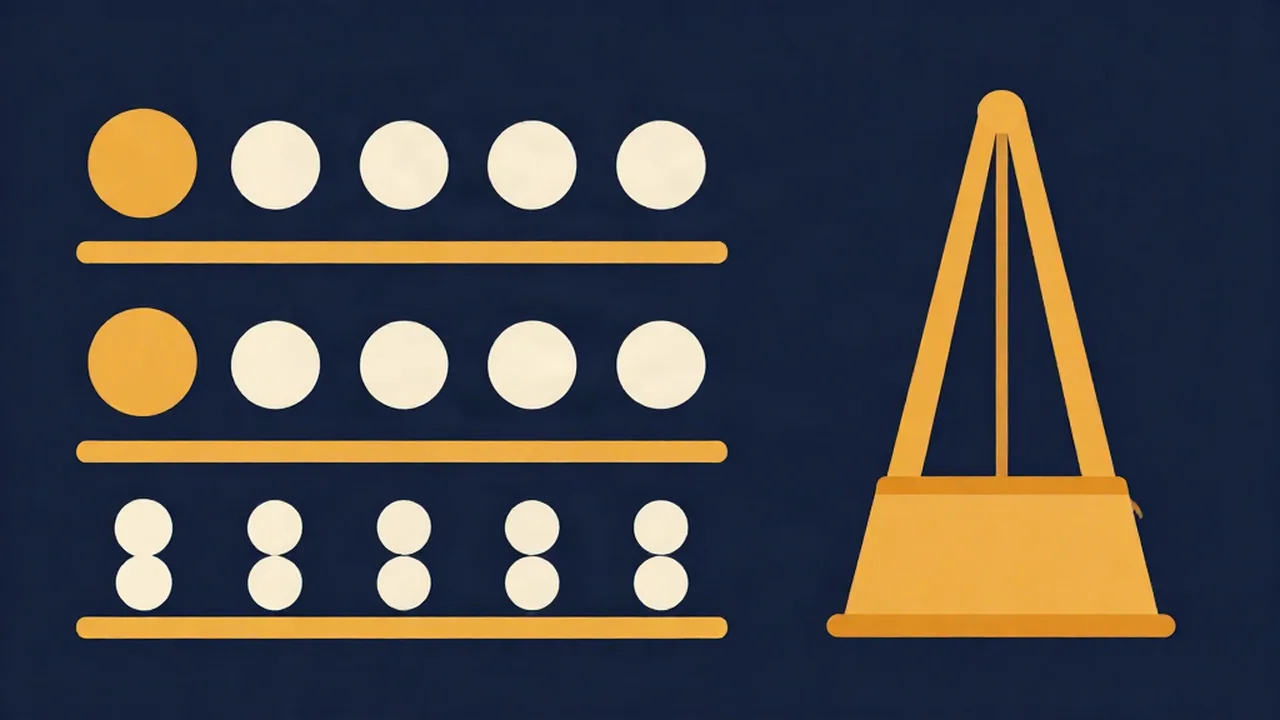
Time signatures explained in one line: the two stacked numbers at the start of a piece tell you how many beats are in each bar (the top number) and which note value counts as one beat (the bottom number), and a Metronome set to the right beats per bar lets you hear exactly what that means. In 4/4 there are four beats per bar and each beat is a quarter note. In 3/4 there are three quarter-note beats. In 6/8 there are six eighth notes per bar, usually felt as two big beats.
That's the whole system. The rest of this guide covers how each common time signature feels, why 6/8 isn't just "six," how to work one out by ear, and how to set any of them on a metronome.
What the top and bottom numbers mean
The top number is a count: how many beats fill one bar (also called a measure). A bar line closes the bar, and counting starts again at one.
The bottom number is not a count. It names a note value, the note that gets one beat. It works like the bottom of a fraction: 4 means a quarter of a whole note, 8 means an eighth, and so on.
| Bottom number | Note that gets the beat | Example |
|---|---|---|
| 2 | Half note | 2/2: two half-note beats per bar |
| 4 | Quarter note | 4/4: four quarter-note beats per bar |
| 8 | Eighth note | 3/8: three eighth-note beats per bar |
| 16 | Sixteenth note | 7/16: seven sixteenths per bar (rare outside complex music) |
So 3/4 reads as "three beats per bar, quarter note gets the beat," and 2/2 reads as "two beats per bar, half note gets the beat." Neither number says anything about speed. That's the tempo's job, which we'll get to.
Simple vs compound meter
Time signatures fall into two families, and the difference is how each beat divides.
Simple meter splits each beat into two. In 2/4, 3/4 and 4/4 you count "1 and 2 and 3 and," with the "and" landing halfway through each beat. If the top number is 2, 3 or 4, you're almost always in simple meter.
Compound meter splits each beat into three. When the top number is 6, 9 or 12, the real beat is a dotted note (a quarter note plus half its value again), and each beat holds three of the smaller notes. You count it "1 and a, 2 and a."
This is the part that trips people up. 6/8 has six eighth notes per bar, but you feel it as two beats, each made of three eighths: ONE-two-three FOUR-five-six. Likewise, 9/8 is three beats of three, and 12/8 is four beats of three.
A quick way to hear the difference between 3/4 and 6/8, which both fit six eighth notes in a bar:
- 3/4 groups them in pairs: 1-and 2-and 3-and. Three beats.
- 6/8 groups them in threes: 1-2-3 4-5-6. Two beats.
Same number of notes, completely different swing.
The common time signatures and how they feel
These are the meters you'll meet most often, along with the feel that gives each one away.
| Time signature | Beats per bar | How it feels | Where you hear it |
|---|---|---|---|
| 4/4 (common time, C) | 4 quarter notes | ONE-two-THREE-four, steady and square | Most pop, rock, hip-hop, EDM and country |
| 3/4 | 3 quarter notes | ONE-two-three, a turning lilt | Waltzes, minuets, many folk songs and hymns |
| 2/4 | 2 quarter notes | ONE-two, brisk and marching | Marches, polkas |
| 2/2 (cut time, ¢) | 2 half notes | Two big beats, light and fast | Marches, show tunes, fast classical passages |
| 6/8 | 2 dotted quarters | ONE-two-three FOUR-five-six, rolling | Ballads, jigs, some lullabies |
| 9/8 | 3 dotted quarters | Three rolling beats | Slip jigs, some classical movements |
| 12/8 | 4 dotted quarters | Four beats, each a triplet | Slow blues, doo-wop and soul ballads, shuffles |
4/4 is so common it's written with a C symbol and called common time. If you can't tell what meter a pop song is in, 4/4 is the safe first guess.
3/4 puts the weight on beat one, then two lighter beats. That's the waltz: ONE-two-three, ONE-two-three.
2/4 and 2/2 both have two beats. In 2/2, written as a C with a line through it, the half note is the beat, so a passage full of quarter notes feels half as busy as it looks. That's why it's called cut time.
6/8 sounds like a gentle rocking or rolling motion at slow tempos and a skipping jig at fast ones. 12/8 is the slow-blues feel: four big beats, with each one split into a triplet.
Odd and irregular meters
Some time signatures don't divide evenly into twos or threes. The most common are 5/4 and 7/8, and the way to play them is to break each bar into smaller groups.
- 5/4 has five quarter-note beats, usually felt as 3+2 (ONE-two-three FOUR-five) or 2+3. It has a lopsided, circling feel.
- 7/8 has seven eighth notes, commonly grouped 2+2+3, 3+2+2 or 2+3+2. Each grouping gives a different groove, and the music tells you which one it uses.
Odd meters show up in progressive rock, jazz, film scores and the folk music of the Balkans and other regions, where 7/8 and longer patterns can be everyday dance rhythms. Count the groups out loud ("1-2, 1-2, 1-2-3") until they stop feeling odd.
How to tell a song's time signature by ear
You don't need the sheet music. Three steps get you there most of the time.
- Find the pulse. Tap your foot or nod along. That steady tap is the beat. If you want a number for it, Tap Tempo BPM Finder: How to Tap Out a Song walks through tapping it out.
- Count to the strong beat. Listen for where the music seems to start over: a big kick drum, a crash cymbal, a chord change. Count your taps between those points. Four usually means 4/4, three means 3/4, two means 2/4 or a compound meter.
- Listen for twos or threes inside the beat. Hum the fastest steady rhythm, such as a hi-hat or strumming pattern. If each beat splits into two, it's simple meter. If it splits into three, you're probably in 6/8 or 12/8.
Don't worry if you land on a different but related answer. A song you count in 4/4 might be written in 2/2, and a slow 6/8 can be counted as six quick beats. Both are fine for practice as long as the bar lines up with the music.
How to set a time signature on an online metronome
On a metronome, the time signature becomes two settings: how many clicks per bar, and what each click stands for. Here's how it works on the Vocal Cut Metronome, which runs in your browser with no install and no account.
The controls you'll use:
- Tempo: the big BPM number, set with the slider (20–300 BPM) or the − and + buttons. It starts at 120.
- Beats per bar: a slider from 1 to 12. It starts at 4, and a row of lights shows each beat as it plays.
- Accent the first beat: on by default. Beat one plays a higher click (1600 Hz) and the other beats a lower one (1100 Hz), so you always know where the bar starts.
- Subdivision: Quarter, Eighths, Triplets or Sixteenths. Subdivision clicks are lower still (800 Hz) and quieter, filling in between the main metronome beats.
- Tap tempo: tap along with a song to set the BPM.
One thing to know before you start: only beat one gets an accent. There's no setting to accent other beats, so for groupings like 3+2 or the middle of a 6/8 bar, you supply that emphasis in your head or with your playing.
The key idea is that a metronome's BPM counts whatever note the click represents. A 120 beats per minute metronome in 4/4 gives you 120 quarter notes a minute, which is 30 bars. Set it to 3 beats and the clicks move at the same speed, but the accent comes round every three, so you get 40 bars a minute.
Recipes for each time signature:
- 4/4: 4 beats per bar. BPM is the quarter note.
- 3/4: 3 beats per bar.
- 2/4: 2 beats per bar.
- 2/2 (cut time): 2 beats per bar, with BPM set to the half-note pulse. If a score says quarter note = 120, set 60.
- 6/8, way one: 6 beats per bar, with each click an eighth note. Good for slow 6/8 where you're still counting every eighth. Beat four isn't accented, so feel it yourself.
- 6/8, way two: 2 beats per bar plus Triplets. Now beats one and four get the main clicks (one accented), with quieter clicks on the eighths in between. BPM here is the dotted-quarter pulse, which suits flowing 6/8. Dotted quarter = 60 in this mode matches 180 in way one.
- 9/8: 3 beats per bar plus Triplets.
- 12/8: 4 beats per bar plus Triplets. The BPM is the dotted-quarter beat, the "four" you tap your foot to in a slow blues.
- 5/4: 5 beats per bar.
- 7/8: 7 beats per bar, each click an eighth note. Count your grouping (say 2+2+3) over the top.
For a full tour of the controls, see How to Use a Metronome (Beginner Guide). If you're putting this to work on an instrument, there are dedicated guides on How to Practice Drums With a Metronome, How to Practice Guitar With a Metronome and How to Practice Piano With a Metronome.
Time signature vs tempo
Time signature and tempo are separate settings, and mixing them up causes a lot of confusion.
- Time signature (meter) is the grouping: how many beats per bar and which note is the beat.
- Tempo is the speed: how many of those beats pass per minute, measured in BPM.
A 3/4 waltz can be slow or fast. A 4/4 song can sit at 70 BPM or 170 BPM. Changing the beats per bar on a metronome changes where the accent falls, not how fast the clicks come. Changing the BPM changes the speed, not the grouping.
Where the two do interact is in how you count. A song at 140 BPM in 4/4 can feel like a slow 70 if you only count the big beats, which is the idea behind Half-Time vs Double-Time: BPM Finder Guide. For more on the speed side, read What Is BPM? Tempo Explained + BPM Finder and Tempo Markings Explained: Largo to Presto, which covers Italian terms like Andante and Allegro. And if you have a recording and want its tempo, BPM Finder can work it out from the file.
New to the device itself? What Is a Metronome? Definition and Meaning covers the basics.
Frequently asked questions
What does 4/4 mean in music? 4/4 means there are four beats in each bar and the quarter note gets one beat. It's called common time and is often written as a C symbol. Most pop, rock and hip-hop is in 4/4, counted ONE-two-three-four, with the strongest accent on beat one.
What does the bottom number of a time signature mean? The bottom number tells you which note value gets one beat, not how many beats there are. A 4 means the quarter note is the beat, an 8 means the eighth note, and a 2 means the half note. The top number is the one that counts beats per bar.
Is 6/8 the same as 3/4? No. Both hold six eighth notes per bar, but they group them differently. 3/4 has three beats, each split into two eighths (1-and 2-and 3-and). 6/8 has two beats, each split into three eighths (ONE-two-three FOUR-five-six), which gives it a rolling, lilting feel.
What is the most common time signature? 4/4 is the most common time signature in Western popular music, which is why it's called common time. Other meters you'll meet often are 3/4, used in waltzes and many folk songs, and 6/8, common in ballads and jigs.
How do I set 6/8 on a metronome? On the Vocal Cut metronome you have two options. Set 6 beats per bar to click every eighth note, which suits slow 6/8. Or set 2 beats per bar with the Triplets subdivision, so the main clicks fall on beats one and four and the BPM is the dotted-quarter pulse, which suits flowing 6/8.
Can a song change time signature? Yes. Many songs and classical pieces switch meter, for example adding a single bar of 2/4 inside a 4/4 song or moving between sections in different meters. The new time signature is written at the point of change. On a metronome, change the beats per bar to match each section as you practice it.