What Is Backmasking? An Audio Reverser Guide
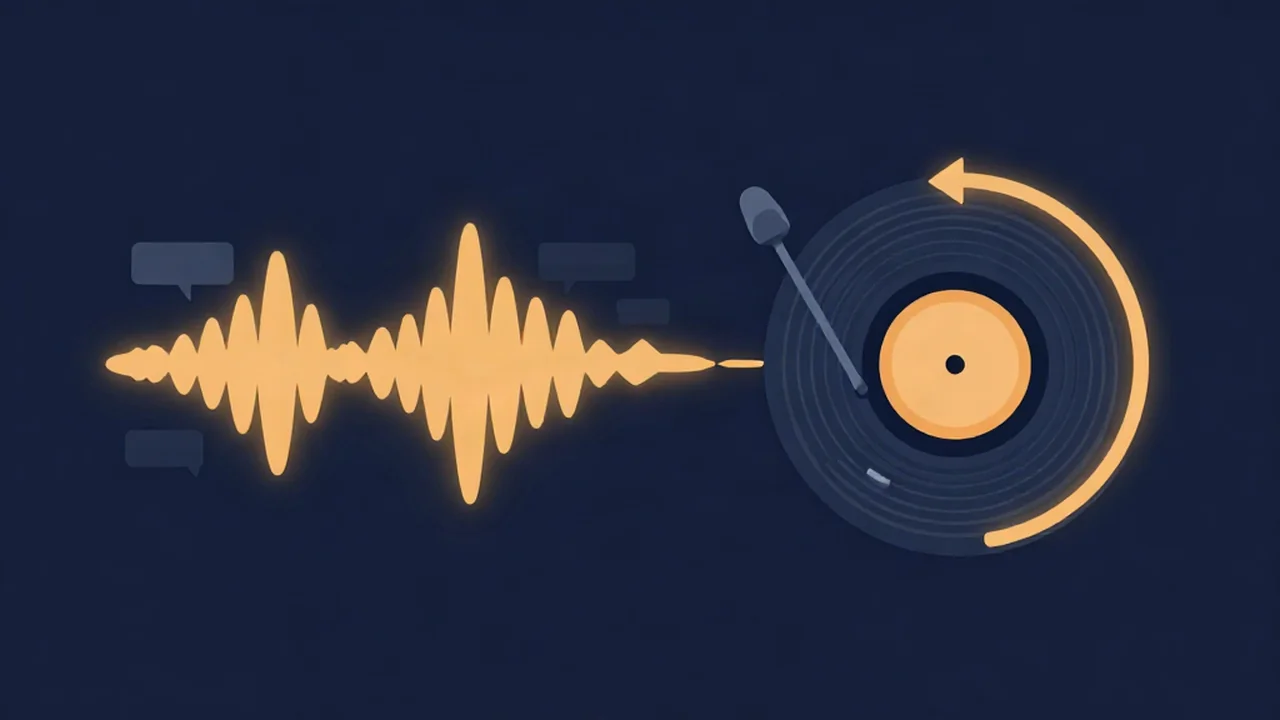
Backmasking is recording a sound, usually a voice, backwards onto a track so it only makes sense when the track is played in reverse, and you can hear it for yourself by running a clip through an Audio Reverser. Technically there's nothing mysterious about it. A reversed file is the same samples played in the opposite order, last one first.
The mystery comes from everything people have claimed to hear in those backwards sounds, from satanic chants to dead Beatles. Most of those claims are about something other than backmasking.
Engineered backmasking vs phonetic reversal
Three different things get lumped together under the word, and keeping them apart settles most arguments.
Engineered backmasking is deliberate. An artist records a phrase, flips it, and puts it in the mix. Play the song backwards and the phrase comes out clear and obvious, because someone built it to.
Phonetic reversal is accidental. Someone plays a normal forward lyric backwards and some of the gibberish happens to sound like words. Nobody put a message there. The listener supplies it, and two people often hear two different "messages" in the same clip.
Forward subliminals aren't reversed at all. These are claims that a word or phrase is hidden in the forward audio, buried under the mix or formed by overlapping sounds. You don't need to reverse anything to check them, so strictly speaking they aren't backmasking.
Most of the famous controversies are phonetic reversals or forward subliminals. Genuine engineered backmasks tend to be jokes, and they're easy to hear once flipped.
A short history of backmasking
Reversed sound arrived in pop through tape. Studios in the 1960s could turn a reel around and play it backwards, and The Beatles used the trick on "Rain" in 1966, which is widely cited as one of the first popular songs with deliberately reversed vocals. It was a texture, not a secret.
The secret-message idea took off in 1969 with the "Paul is dead" rumour. Fans played "Revolution 9" backwards and heard its repeated "number nine" as "turn me on, dead man." That's a phonetic reversal: a forward phrase that, flipped, sounds a bit like something else if you're told what to listen for.
In the early 1980s the idea turned into a moral panic. In April 1982 a California State Assembly committee held a hearing where "Stairway to Heaven" was played backwards and witnesses described the satanic lines they said were hidden in it. Assemblyman Phil Wyman introduced a bill, AB 3741, that would have required warning labels on records containing backmasking. A federal bill along the same lines, H.R. 6363, was introduced in Congress the same year and never passed.
The most serious case came in 1990 in Reno, Nevada. The families of two young men who had shot themselves sued Judas Priest, arguing that a hidden "do it" on the album Stained Class had pushed them to it. That alleged "do it" was a forward subliminal, not a backmask. Judge Jerry Carr Whitehead heard the case without a jury and ruled for the band and CBS, finding no evidence that they had intentionally placed subliminal messages on the record.
Musicians answered the panic with jokes. ELO put a reversed spoken message on "Fire on High" (1975) that, played the right way round, is drummer Bev Bevan pointing out that music can be reversed but time can't. Pink Floyd hid a spoken note in "Empty Spaces" on The Wall (1979) congratulating anyone who'd found the secret message. "Weird Al" Yankovic's "Nature Trail to Hell" (1984) includes a reversed line that turns out to be "Satan eats Cheez Whiz."
Reversal also has dull, practical uses. Radio edits have long flipped a swear word so the line still flows without the word being intelligible, and producers use reversed cymbals, guitars and reverb tails as sound design.
Why you hear words that aren't there
Your brain doesn't wait for sound to be clear before deciding what it is. It guesses, constantly, using what it expects to hear. Played backwards, speech keeps a lot of its rhythm and many of its vowel sounds, so it sits right on the edge of sounding like language. The brain fills the gap. This is auditory pareidolia, the listening version of seeing faces in clouds.
Expectation is the strongest part of it. Psychologists call it top-down processing: what you already believe shapes what you perceive. Play someone a reversed clip cold and they'll usually hear mush. Show them the "lyric" first and they hear it plainly, and after that they can't unhear it. That's why most backmasking demonstrations give you the words before or during playback.
The best-known study on this is John Vokey and J. Don Read's 1985 paper "Subliminal Messages: Between the Devil and the Media," published in American Psychologist. In their experiments, listeners could not work out the meaning of backward messages, and the messages had no measurable effect on their behaviour. The authors concluded that the messages people report come from the listener's own active construction of the sound, not from anything encoded in it.
That's also why "reverse speech," the claim promoted by David John Oates that people unconsciously say hidden truths backwards in everyday talk, is widely regarded as pseudoscience. It relies on the same primed listening.
One naming trap: backmasking is not the same as "backward masking." Backward masking is a psychoacoustics term for a later sound making an earlier, very short sound harder to hear. Different idea, similar name.
How to check a backmasking claim with an online audio reverser
You can run a fair test yourself on a song file you already own. You don't need an audio reverser app or any install. The free Audio Reverser opens MP3, WAV, FLAC and M4A files in the browser, and your audio never leaves your device. There's no account. If the track only exists inside a video file, pull the soundtrack out with Video to Audio first, then reverse that.
- Trim to the section. The reverser flips the whole file, with no selection range, so cut out the few seconds the claim is about using the Audio Cutter. How to Cut Audio Without Losing Quality explains how to do it cleanly.
- Reverse it. Drop the trimmed clip into the Audio Reverser. It shows "Reversing…" while it works, then gives you a preview button.
- Listen before you read the claim. This is the step that matters. Play it two or three times and write down anything you hear, even if it's nothing. Better still, ask someone who doesn't know the claim to do the same.
- Now read the claimed phrase and listen again. Note how much clearer it suddenly seems.
If you only hear the phrase after being told it, that's phonetic reversal plus priming. If you heard a clear, specific phrase cold, and so did your friend, you may have found an engineered backmask. Those usually sound like actual reversed speech, a recognisable voice saying words, rather than garbled singing.
Reversing itself is lossless: the samples are only reordered, not altered, so reversing the reversed clip gives you back what you started with. If you plan to reverse something more than once, export WAV each time (it's the default; MP3 and Opus are also offered), since each MP3 encode adds its own small artifacts.
You can also look rather than listen. In a spectrogram, as explained in What Is a Spectrogram?, reversed speech still shows the stacked horizontal bands of vowel resonances, but the glides between them run the wrong way. What Are Formants? A Pitch Changer Guide explains those bands. A waveform view, covered in What Is a Waveform?, shows the loudness shape flipped: sharp attacks turn into slow swells that cut off suddenly.
Making your own backmask
The fun direction is the creative one. Record a short phrase with the Audio Recorder or take a dry vocal you have, reverse it, and place the reversed clip somewhere in your track. Listeners who flip the song will hear it come out the right way round. How to Reverse Audio (Play It Backwards) walks through the reversing step, and Reverse Reverb Swell With an Audio Reverser shows a related trick that uses two reversals to make reverb rise into a word.
If you're reversing someone else's vocal rather than your own, flipping it doesn't change who owns it. Copyright and Fair Use in Music Sampling covers what that means for a release.
More definitions like this one are in the Audio Explainers hub.
Frequently asked questions
What was the first song with backmasking?
There's no agreed first, because reversed sounds were used in experimental tape music before pop picked them up. The Beatles' "Rain" (1966) is widely cited as one of the first popular songs with deliberately reversed vocals, and its success helped make reversed tape a common studio effect in the late 1960s.
Is Stairway to Heaven backmasked?
There's no evidence Led Zeppelin deliberately put a reversed message in "Stairway to Heaven." The claimed satanic lines are a phonetic reversal: forward lyrics that, played backwards, can sound like words once you're told what to expect. Listeners who hear the clip without being primed usually report gibberish or very different phrases.
Can backmasked messages affect you subliminally?
Research doesn't support it. In Vokey and Read's 1985 study, listeners couldn't extract the meaning of backward messages, and the messages didn't change their behaviour. The messages people hear seem to come from their own expectations rather than from anything hidden in the recording, which is why priming matters so much.
Is backmasking illegal?
Not in itself. Putting reversed audio in a song is an ordinary production choice. Lawmakers proposed warning-label bills in the early 1980s, including AB 3741 in the California State Assembly and the federal H.R. 6363, which never passed. Copyright still applies, so reversing someone else's recording doesn't make it yours to release.
How do I play a song backwards?
Open the song file in a free audio reverser such as Vocal Cut's Audio Reverser, which accepts MP3, WAV, FLAC and M4A. It reverses the file in your browser, lets you preview it, and exports WAV, MP3 or Opus. Your audio never leaves your device. Trim the file first if you only want one section reversed.