Integrated vs Short-Term vs Momentary LUFS
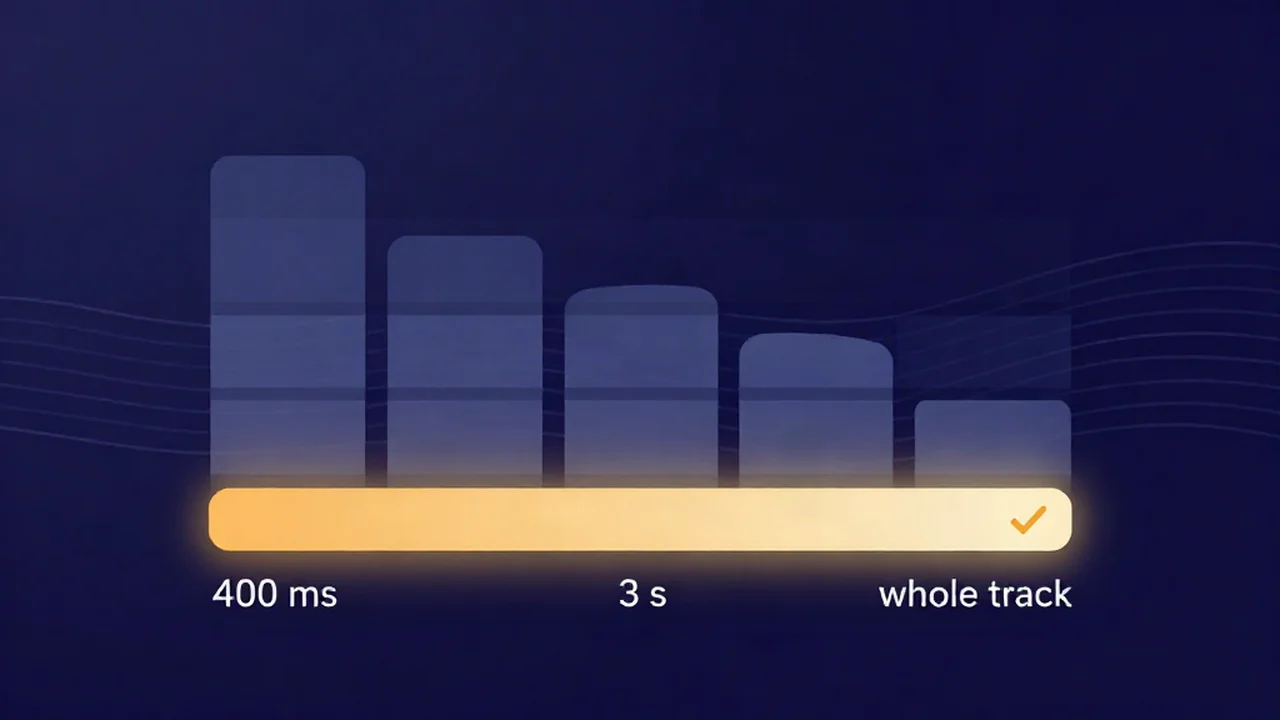
The difference between integrated vs short-term LUFS is the time window each one measures over, and only one of them decides whether a streaming service turns your track up or down. Integrated LUFS is the loudness of the whole song, measured start to finish. Short-term is the loudness of the last 3 seconds. Momentary is the loudness of the last 400 milliseconds. If you only remember one thing: platforms normalize on the integrated number, and that is the single value the free Volume Normalizer measures and matches for you.
All three are the same underlying measurement in the same unit, LUFS (Loudness Units relative to Full Scale, sometimes written LKFS — they mean the same thing). They all run your audio through the same K-weighting filter defined by ITU-R BS.1770 and EBU R128, a curve that rolls off the deep bass and lifts the presence range so the meter reads loudness closer to how your ears weigh it. What separates the three readings is nothing but the length of the slice they average over.
The three LUFS time windows at a glance
Here is the whole thing in one table. Everything below is just this, expanded.
| Window | Time it averages | Gated? | What you use it for |
|---|---|---|---|
| Momentary (M) | 400 ms (0.4 s) | No | Catching a single loud hit or peak moment |
| Short-term (S) | 3 s (3000 ms) | No | How loud a section — a chorus, a drop — sits |
| Integrated (I) | the whole track | Yes | The one target streaming platforms normalize to |
A LUFS meter shows all three at once while audio plays: momentary and short-term flicker along with the music, and integrated slowly settles toward a single number as the track runs.
Momentary loudness: the 400 ms window
Momentary loudness answers "how loud is it right now?" It slides a 400ms window across the audio and reports the loudness of just that last fraction of a second, updating constantly. Nothing is gated out, so it reacts to everything — a snare crack, a vocal consonant, a synth stab all push it up the instant they happen.
That twitchiness is the point. You do not aim for a momentary target; you watch it to spot moments. If the momentary reading spikes far above the rest of the track on one drum fill, that fill is going to feel jarring, and the momentary meter is where you see it before your ears fully register why. Think of it as the meter's reflexes.
Short-term loudness: the 3 second window
Short-term loudness averages the last 3 second window — long enough to smooth over individual transients, short enough to still track the shape of the song. It tells you how loud a section is rather than a single hit.
This is the reading to glance at when you want to know how your chorus compares to your verse, or whether the quiet intro is so far down that listeners will reach for the volume knob before the song opens up. A verse sitting at -18 short-term and a chorus at -11 is a 7 LU jump — that contrast might be exactly what you want, or it might be more than a casual listener will sit through. Short-term is where you feel that decision out. It moves, but it moves at the pace of arrangement, not the pace of individual drum hits.
Integrated loudness: the whole-program number
Integrated loudness — also called program loudness — is one number for the entire file, and it is the number that actually matters when you upload. It answers "how loud is this song, overall?" and it is the value every major streaming service compares against its own target.
Getting to that single figure is a gated loudness measurement, which is the part that makes integrated different from just averaging everything. The measurement is built from overlapping 400 ms blocks (75% overlap), and then two gates throw some of those blocks away before the average is taken, per BS.1770-4:
- Absolute gate at -70 LUFS. Any block quieter than -70 LUFS is treated as silence and dropped. This stops the gaps between phrases, fade tails, and dead air from dragging the number down.
- Relative gate at -10 LU below the average of the blocks that survived the first gate. This drops the genuinely quiet passages so the integrated figure reflects the loudness of the music you actually hear, not an average diluted by soft intros and breakdowns.
Without that gating, a song with a long ambient intro would measure much quieter than it sounds, and you would over-compensate by pushing the loud parts too hard. The gates are what make integrated loudness track perceived loudness across a whole track instead of getting fooled by the quiet bits.
Which number streaming platforms actually use
Every major platform normalizes on integrated loudness, full stop. They measure your uploaded track's integrated LUFS, compare it to their reference target, and turn the whole track up or down by the difference so it sits at a consistent level next to everything else in a playlist. Momentary and short-term never enter into it.
The commonly published reference targets, framed as "around" because platforms adjust them and apply them slightly differently:
- Spotify — around -14 LUFS integrated
- YouTube — around -14 LUFS integrated
- Amazon Music — around -14 LUFS integrated
- Apple Music — around -16 LUFS integrated
So if your master reads -9 LUFS integrated and you upload to Spotify, it gets turned down roughly 5 LU to land near -14. Master to -20 and it may get turned up. Either way, the number that moved you was the integrated one. This is why chasing a hot master mostly backfires on streaming — for the full mechanics, see how streaming loudness normalization works, and if you are weighing whether to normalize, master, or just boost, that comparison is worth a read. The whole reason platforms adopted this was to end the loudness war, where everyone squashed masters to win a volume contest that normalization simply cancels out.
So which number do I set?
For the upload target, you set the integrated value. That is the whole game: pick the platform's integrated target (or a sensible -14 LUFS if you are covering several at once), measure your track's integrated loudness, and adjust. For a fuller discussion of picking that figure, see what LUFS you should master to.
The convenient part is that the free Volume Normalizer measures integrated loudness — the exact BS.1770-4 calculation described above, 400 ms gating blocks with the -70 absolute and -10 relative gates, computed right in your browser. Its LUFS reading is the integrated number, the same one Spotify and Apple Music normalize against, so the figure you match is the figure the platform sees. Your audio never leaves your device while it does this; the measurement and the gain change both happen locally.
Momentary and short-term stay in the working-while-you-mix column. You watch momentary to catch a moment that jumps out, glance at short-term to judge how a section sits, and set your final level by integrated. Two more readings often share the same LUFS meter but answer different questions: loudness range (LRA), which measures the spread between your quiet and loud sections, and true peak (dBTP), which is a peak-ceiling reading, not a loudness one, and belongs in its own conversation. And if the term LUFS itself is still fuzzy against the older meters you have seen, LUFS vs RMS vs dBFS lays out how they relate.
For more loudness explainers, the explainers hub collects the rest of the set.
Frequently asked questions
Which LUFS number do streaming platforms use to normalize my track?
Integrated loudness — the single value measured across your whole song, gated per ITU-R BS.1770-4. Platforms like Spotify, YouTube, and Apple Music measure your track's integrated LUFS, compare it to their reference target (around -14 LUFS for most, -16 for Apple Music), and turn the whole track up or down to match. Momentary and short-term readings play no part in normalization.
What is the difference between integrated and short-term LUFS?
The time window. Short-term LUFS averages the last 3 seconds and updates constantly, so it tracks how loud a section sits. Integrated LUFS averages the entire track into one gated number. Short-term is a moving reading you watch while working; integrated is the fixed, whole-program figure you set as your upload target.
Why is integrated loudness gated but momentary and short-term are not?
Gating removes silence and quiet passages so the whole-track number reflects the loudness you actually hear, not an average diluted by fade tails and soft intros. A -70 LUFS absolute gate drops near-silence; a -10 LU relative gate drops quiet sections. Momentary and short-term are live, moment-to-moment readings, so gating them would defeat their purpose.
Do I need to hit the momentary or short-term LUFS target too?
No — there is no momentary or short-term "target" to hit. Only integrated loudness is a target, because that is what platforms normalize against. Momentary (400 ms) and short-term (3 s) are diagnostic readings: you watch momentary to catch a jarring loud moment and short-term to judge how sections balance. Your final level decision is made on the integrated number.