Drop D Tuning: How to Tune Your Guitar
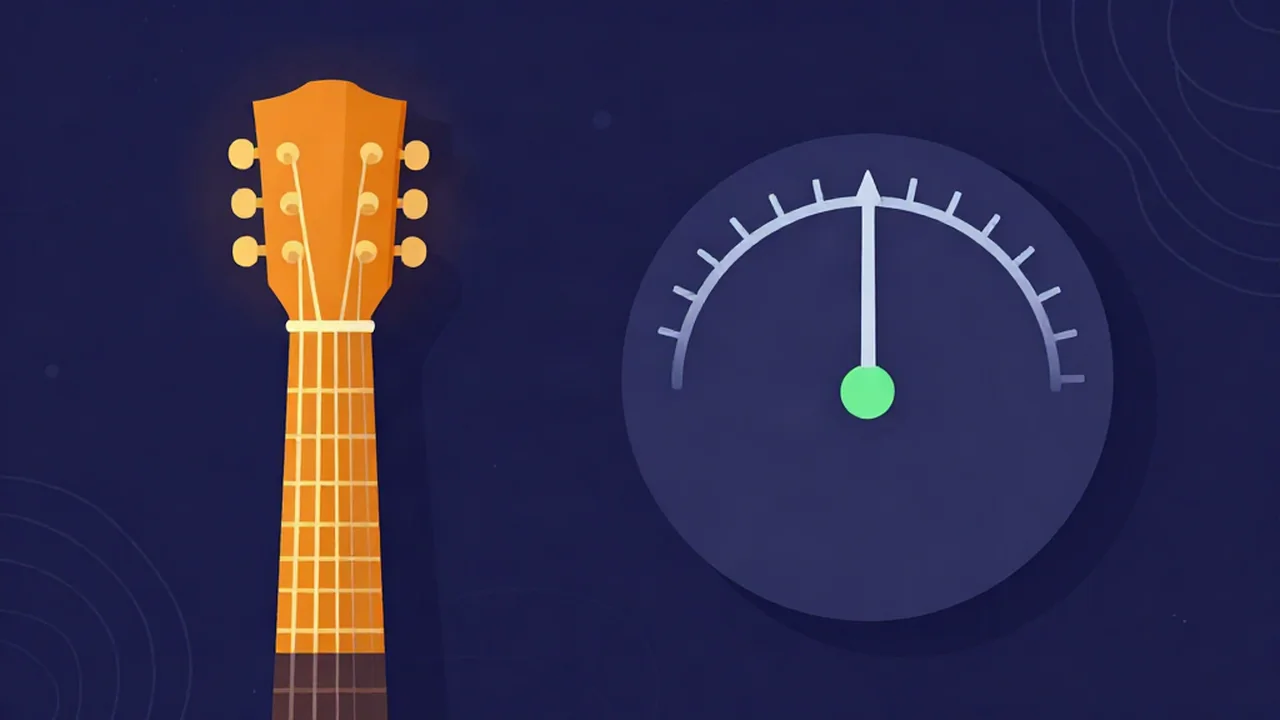
To get into drop D tuning, open the Guitar Tuner, switch it to Chromatic, and lower only your 6th (thickest) string by a whole step, from E2 down to D2 (73.42 Hz). The other five strings stay in standard, so the guitar reads D2 A2 D3 G3 B3 E4 from low to high. If the guitar is already in standard tuning, the whole job takes about a minute.
What drop D tuning is (and why players use it)
Drop D changes one string. The other five stay exactly where standard tuning puts them.
| String | Standard | Drop D | Frequency (A4 = 440 Hz) |
|---|---|---|---|
| 6th (thickest) | E2 | D2 | 73.42 Hz |
| 5th | A2 | A2 | 110.00 Hz |
| 4th | D3 | D3 | 146.83 Hz |
| 3rd | G3 | G3 | 196.00 Hz |
| 2nd | B3 | B3 | 246.94 Hz |
| 1st (thinnest) | E4 | E4 | 329.63 Hz |
Most players reach for it because of power chords. With the bottom three strings tuned D A D, one finger laid flat across them at any fret gives you a root-fifth-octave chord, and sliding that one finger around is how a lot of heavy riffs are built.
It also buys you a lower bottom note. The open 6th string goes down to D, two semitones below anything a standard-tuned guitar can reach. And in songs in D or D minor, that low string can ring as a drone under chords played higher up the neck. Rage Against the Machine's "Killing in the Name" and the Beatles' "Dear Prudence" are both in drop D.
The tradeoff: every note on the 6th string now sounds two semitones lower, so to play the same note as before you fret two frets higher. Shapes on the other five strings are unaffected.
For why the six standard notes sit where they do, see Standard Guitar Tuning: The EADGBE Notes.
Why your guitar tuner fights you on drop D
The Vocal Cut tuner opens in Guitar mode, and Guitar mode only knows standard tuning. Every reading snaps to the nearest of the six standard strings: E2, A2, D3, G3, B3 or E4. There is no D2 in that list.
So when you pluck a correctly tuned drop D string, the tuner compares it with the closest standard string, E2. D2 is two semitones (200 cents) below E2, so the needle pins hard left and the hint reads "Far too low — tighten the string". Follow that advice and you tune the guitar straight back to standard.
Chromatic mode fixes this. Instead of snapping to a string, it snaps to the nearest semitone and shows the note name the string is actually playing, plus how many cents sharp or flat it is. A string at D2 reads as D2.
That's what to look for in any guitar tuner for drop D: a chromatic mode, or a preset that lists D2 as a target.
How to tune to drop D with an online guitar tuner
- Open the Guitar Tuner and select Chromatic from the row of instrument buttons (Chromatic, Guitar, Bass, Ukulele, Violin). Leave "A4 =" at 440 Hz unless you're matching another instrument.
- Press the amber "Start tuner" button and allow the microphone when the browser asks. The hint changes to "Listening… pluck a single string and let it ring". The sound is analysed live in your browser, so your audio never leaves your device.
- Check the other five strings first. If they aren't in standard already, tune them before touching the 6th string. You can do this in Chromatic or Guitar mode; the step-by-step is in How to Tune a Guitar With an Online Tuner.
- Pluck the 6th string and loosen it. The display starts at E2, then passes through D♯2 as you lower the pitch. Keep going until it reads D2.
- Go slightly below D2, then tighten back up into it. Tuning up to a note seats the gears in the tuning machine under tension, so the string is less likely to creep flat as you play. Stop when the needle sits on the centre line.
- Wait for green. The note and needle turn green and the hint reads "In tune" once you're within 5 cents of D2. The small readout shows something close to "73.4 Hz".
- Re-check all six strings. Dropping one string's tension changes the pull on the neck, which can nudge the others slightly flat or sharp.
- Press "Stop tuner" when you're done to release the microphone.
Check it by ear (no tuner)
You can confirm the tuning without a tuner, because the low D sits exactly one octave below the open 4th string.
- 12th-fret harmonic. Lightly touch the 6th string directly above the 12th fret and pluck. That harmonic is D3, the same note as the open 4th string. Play them together and adjust the 6th string until the wobble between them stops.
- 7th fret against the open A. Fret the 6th string at the 7th fret. In drop D that's A2, which should match the open 5th string. (In standard tuning you'd use the 5th fret; the two-fret shift is drop D in action.)
For a reference tone, switch the tuner to Guitar mode and tap the D3 button in the "Strings — tap to hear the reference note" row. There's no D2 button, since Guitar mode's targets are E2 through E4, but D3 is the octave above your target and matches the 12th-fret harmonic.
Troubleshooting
The tuner reads E, or jumps an octave
If it says E2 with a pinned needle, you're still in Guitar mode. Switch to Chromatic.
If the reading leaps between D2 and D3, the tuner is catching the string's overtones. Low strings are rich in them, especially in the first moment after the pluck. Pluck softly with the flesh of your thumb rather than a pick, let the attack die away for a second, and rest your fretting hand across the other five strings so only one rings.
It shows nothing, or the reading wanders
The tuner switches off the browser's noise suppression and automatic gain so it hears the string as it really sounds, which means it hears the room too. Move the guitar close to the mic and turn off fans and music. If nothing registers at all, the Mic Test shows whether any sound is reaching the browser.
The string feels floppy or buzzes
Lower pitch means lower tension, so the 6th string is slacker in drop D. On light-gauge sets that can mean fret buzz, especially if you pick hard. If you play in drop D most of the time, many players fit a heavier 6th string or have the guitar set up for it.
It won't stay in tune
New strings keep stretching for a while. Tune up into the note, not down to it, and if the 6th string keeps creeping flat, play for a few minutes and retune.
Going back to standard, and related tunings
To return to standard, tighten the 6th string back up to E2 (82.41 Hz). Guitar mode works normally again once you're there, and you'll see E2 go green.
A few close relatives:
- Double drop D lowers both E strings to D: D A D G B D. Tune the 1st string down to D4 the same way, in Chromatic mode.
- Drop D on bass lowers the bass's E string to D1. Because that's close to the bottom of what the tuner detects, How to Tune a Bass With an Online Bass Tuner suggests tuning its 12th-fret harmonic instead.
The frequencies in this guide assume A4 = 440 Hz. The tuner's "A4 =" field accepts 415 to 466 Hz if you're matching a band or recording at a different reference; What Is Concert Pitch? A Pitch Changer Guide explains when you'd change it. For what the cents on the readout mean, see Semitones and Cents: A Pitch Changer Guide, and the rest of the audio how-to guides cover the other tools.
Frequently asked questions
What note is the low string in drop D?
In drop D tuning the 6th string, the thickest one, is tuned to D2, which sounds at 73.42 Hz when the reference is A4 = 440 Hz. That's a whole step (two semitones) below the standard E2 at 82.41 Hz. The other five strings stay at A2, D3, G3, B3 and E4, so the full tuning reads D A D G B E from low to high.
Do I need a special guitar tuner for drop D?
No, but you need a tuner that can show notes other than the six standard strings. A chromatic tuner works, because it displays whatever note you're playing. A tuner locked to standard guitar strings will read D2 as a very flat E2 and tell you to tighten it. On the Vocal Cut Guitar Tuner, select Chromatic mode before tuning the low string.
Is drop D tuning bad for my guitar?
No. Drop D lowers the tension on one string, which is well within what any guitar is built for. The main side effect is a slacker 6th string, which can buzz on light-gauge sets. Players who stay in drop D often fit a heavier low string or get a setup to suit it. Switching between standard and drop D regularly does no harm.
What is the difference between drop D and D standard?
Drop D lowers only the 6th string, from E to D, and leaves the rest in standard tuning: D A D G B E. D standard lowers all six strings by a whole step: D G C F A D. In D standard every chord shape works exactly as in standard, just lower. In drop D only shapes using the 6th string change, and the bottom three strings form a one-finger power chord.
Can I play standard chords in drop D?
Yes, for most of them. Any chord that doesn't use the 6th string, such as open A, C or D shapes played from the 5th or 4th string, sounds the same as in standard tuning. Chords that include the 6th string need that string fretted two frets higher to get the same note. Open D and D-based chords gain a full, ringing low D for free.