Relative Major and Minor Keys: Key Finder Guide
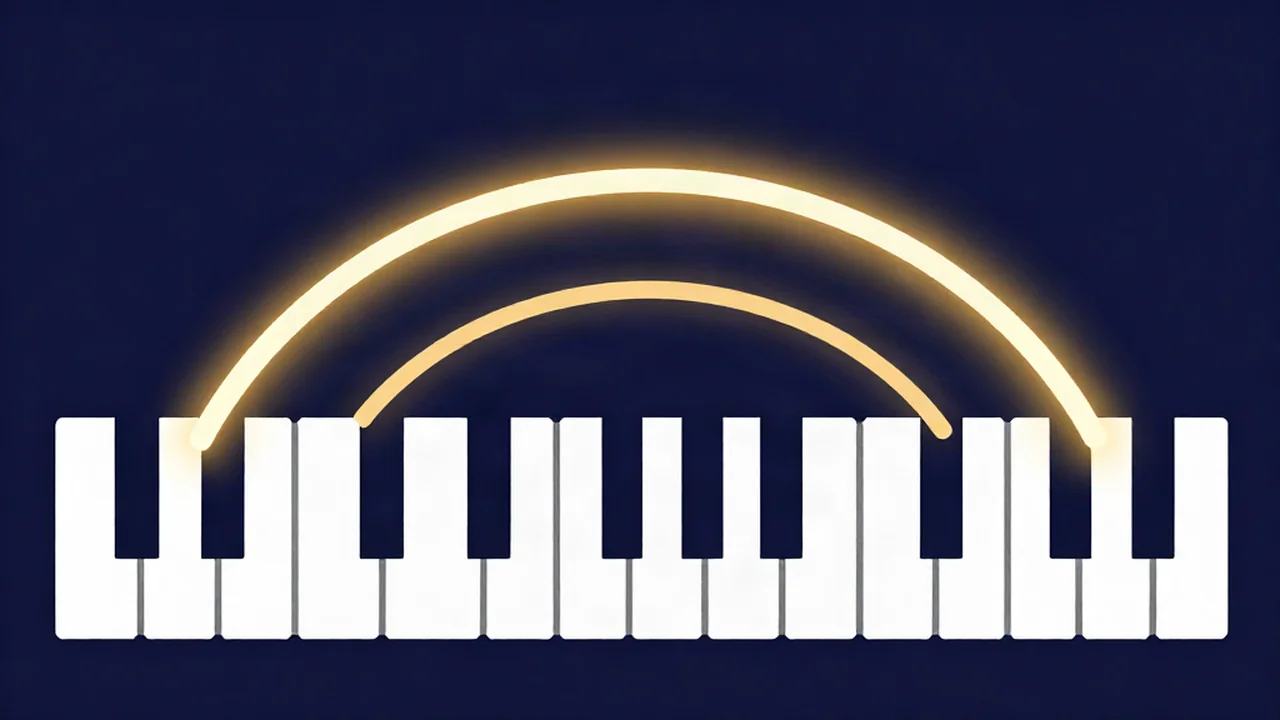
If a key finder tells you a song is in A minor and a chord chart says C major, both might be describing the same set of notes. Those two are relative keys: a major key and a minor key that share all seven notes and the same key signature. The relative minor sits a minor third (3 semitones) below the major key's tonic, so C major's relative minor is A minor. Go the other way and the relative major sits a minor third above the minor tonic.
What separates them is which note sounds like home. If you need a refresher on what a key is in the first place, start with what musical key means.
Why C major and A minor share the same notes
C major uses C, D, E, F, G, A and B, with no sharps or flats. A natural minor uses A, B, C, D, E, F and G. Same seven notes, different starting point.
That's the whole trick. The natural minor scale is the major scale started on its 6th degree. Count up C major (C is 1, D is 2, and so on) and A lands on 6. Play the white keys from A to A and you get A minor.
The notes don't change, but the tonal center does. In C major, melodies pull toward C and the C major chord feels like rest. In A minor, the same notes orbit A, and the A minor chord is where things settle. That shift of gravity is why the two keys feel different even though they share every note.
How to find the relative minor or major
The rule works in both directions:
- Major to relative minor: count down 3 semitones from the tonic, or take the 6th note of the major scale. G major goes down to E, so its relative minor is E minor.
- Minor to relative major: count up 3 semitones from the tonic, or take the 3rd note of the minor scale. D minor goes up to F, so its relative major is F major.
Here are all 12 pairs with their key signatures:
| Major key | Relative minor | Key signature |
|---|---|---|
| C major | A minor | none |
| G major | E minor | 1 sharp |
| D major | B minor | 2 sharps |
| A major | F# minor | 3 sharps |
| E major | C# minor | 4 sharps |
| B major | G# minor | 5 sharps |
| F# major | D# minor | 6 sharps |
| Db major | Bb minor | 5 flats |
| Ab major | F minor | 4 flats |
| Eb major | C minor | 3 flats |
| Bb major | G minor | 2 flats |
| F major | D minor | 1 flat |
If you use DJ notation, relative keys are easy to spot: they share a number on the Camelot wheel. C major is 8B, A minor is 8A. Same number, different letter.
Relative vs parallel keys
People mix these up a lot. Parallel keys share a tonic, not a set of notes. C major and C minor are parallel keys: both treat C as home, but C minor has three flats (Bb, Eb and Ab) where C major has none.
So:
- Relative keys (C major / A minor): same notes, different home note.
- Parallel keys (C major / C minor): same home note, different notes.
Switching to the parallel key changes the mood sharply, because three notes actually change. Switching to the relative key is subtler. The palette stays put and only the emphasis moves.
How to hear whether a song is major or minor
Since relative keys share notes, a list of notes can't settle the question. Your ear has to. A few things help:
- Where the melody comes to rest. Hum the last note of the chorus. If it lands on A and feels finished, you're probably in A minor. If it lands on C, probably C major.
- What the bass does. Bass lines lean on the tonic, especially at the ends of phrases.
- The final chord. Songs usually end on the home chord. A minor chord at the very end points to the minor key.
- A raised 7th. Minor-key songs often borrow the harmonic minor's raised 7th to make a stronger pull home. In A minor that's G#, a note C major doesn't contain. Hear an E major chord resolving to A minor and that G# is a strong hint.
Why a song key finder sometimes reports the relative key
It helps to know how the detection works. Vocal Cut's Key Finder decodes your file in the browser (your audio never leaves your device) and adds up how much energy each of the 12 pitch classes carries across the whole track. That gives a 12-bar chroma profile (energy per note name, ignoring octave), which the tool shows you. It then compares that profile against 24 reference profiles, one for each major and minor key, using the Krumhansl–Schmuckler method, and picks the best match.
Here's the catch. Relative keys use the same notes, so their reference profiles look alike, and a track's chroma can correlate almost as well with A minor as with C major. The gap between the winner and the runner-up can be small. The confidence percentage the tool reports blends the strength of the best match with that gap, so a low or moderate confidence on a song you suspect is relative-ambiguous is worth noticing. The tool shows one key, not a ranked list, so check the alternative yourself with the table above.
Some songs really do sit in both. A verse in A minor and a chorus that lifts into C major is a common move. Summing the whole track blurs that into one answer, and neither answer is exactly wrong.
The practical check is simple: take the result, look up its relative key, and listen for which one the song resolves to. For a full walkthrough, see how to find the key of a song. If you're DJing, the distinction barely matters, as the next section explains.
When the relative key matters (and when it doesn't)
For mixing, relative keys are interchangeable. A track in 8A and a track in 8B share every note, so they blend without clashing. That's why the same-number move is a staple of beatmatching and key matching.
For singing, playing and transposing, the tonal center matters. The chords change depending on which key you're actually in. A song in A minor centers on Am, Dm and E. In C major the center is C, F and G. Writing out chords from the wrong one gets you the right notes in the wrong roles.
It matters for pitch shifting too. Say you want to move a backing track to suit your voice. You need to know where the song lives to pick a comfortable target, and our guide on changing a karaoke track's key covers that. The Pitch Changer handles the shift itself.
If you want a tempo and key finder workflow for prepping a set, pair the Key Finder with the BPM Finder. Run each track through both and you have the two numbers that decide what mixes well. A key finder for music gives you the starting point; your ear settles the relative question.
Frequently asked questions
Is A minor the same as C major? No, but they're relatives. A minor and C major share the same seven notes and the same key signature, with no sharps or flats. The difference is the tonal center: A minor resolves to A, C major resolves to C.
What is the relative minor of G major? E minor. Count down 3 semitones from G (G to F# to F to E), or take the 6th note of the G major scale. Both keys have one sharp, F#.
Why does my key finder say minor when the song sounds major? Relative keys share all their notes, so a key finder comparing pitch-class energy can land on the relative minor instead of the major, especially when the confidence is low. Look up the relative major and listen for which note the song resolves to.
Do relative keys sound good together? Yes. Because they use the same notes, songs in relative keys mix without clashing. On the Camelot wheel they share a number, like 8A and 8B.
What is the difference between relative and parallel keys? Relative keys share notes but have different tonics (C major and A minor). Parallel keys share a tonic but have different notes (C major and C minor, which differ by three flats).